

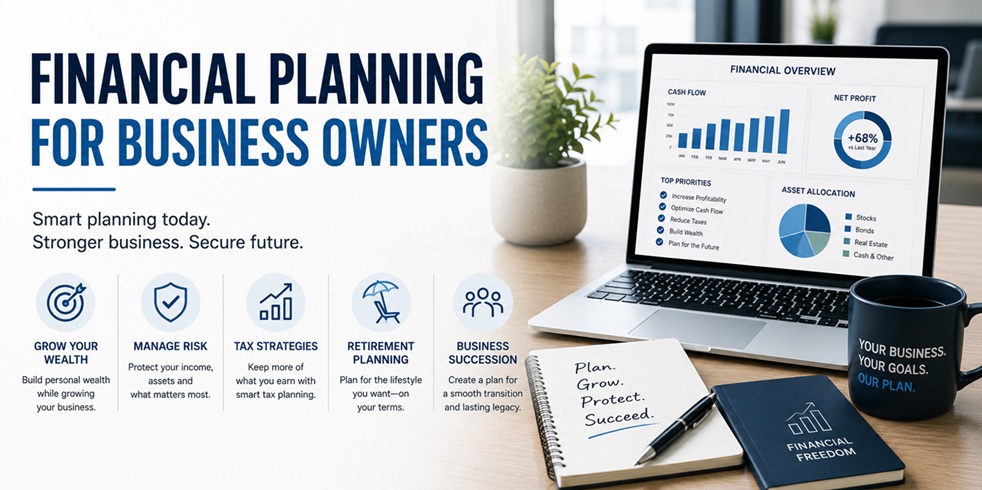
Financial planning for business owners requires a different approach than planning for W-2 employees, because the business itself is usually the owner’s largest, most concentrated, and most illiquid asset. Standard retirement advice — “max your 401(k), diversify, automate” — fails because it assumes diversified income and easily transferable assets, neither of which most owners have.
The owner-specific work centers on four things: separating personal and business finances cleanly, building personal liquidity outside the business, planning the eventual exit years before it happens, and using retirement vehicles designed for self-employed income (which can shelter 5–10x more than a standard 401(k)).
The 4 Blind Spots in Owner Financial Plans
Over-concentration. For many owners, the business is 70%+ of net worth. That’s a level of single-asset exposure no advisor would recommend for any other position. Yet the business is also the source of income, identity, and decision-making power. The math says diversify; reality is most owners don’t, until they’re forced to.
No formal succession plan. Surveys consistently show fewer than half of business owners have a written succession plan. The most common version is “I’ll figure it out when I’m ready to sell” — which usually means selling at a worse price under more pressure than a planned exit.
Inadequate personal liquidity. Owners often funnel everything back into the company, leaving the household exposed if business cash flow stutters. A 6-month personal emergency fund is non-negotiable — separate from any business reserves.
Confusing business cash flow with personal wealth. A profitable business doesn’t equal a wealthy owner. Profit retained, used for inventory, or tied up in receivables isn’t money you can spend.
Retirement Vehicles Owners Should Know
| Vehicle | Annual Contribution Limit | Best For |
|---|---|---|
| SEP-IRA | 25% of compensation, up to ~$69,000 | Simple setup, no/few employees |
| Solo 401(k) | ~$69,000 (~$76,500 age 50+) | Owner-only or owner-plus-spouse |
| Defined Benefit plan | Up to ~$280,000+ depending on age | High-income owners near retirement |
| SIMPLE IRA | ~$16,000 (~$19,500 age 50+) | Small businesses with a few employees |
The Defined Benefit plan is the most underused. A 55-year-old owner making strong income can shelter several hundred thousand dollars a year, far more than any other vehicle. Check current IRS limits each year — they move.
Exit Planning: Start 5–7 Years Out
Owners who get the best exit valuations start preparing at least five years before they want to sell. The work:
- Clean books that an outside buyer can diligence in weeks, not months
- Reduce key-person risk — the business shouldn’t grind to a halt without you
- Diversify the customer base — no single customer over 15–20% of revenue
- Document processes — what’s in your head needs to be on paper
- Build the management team that survives the sale
A business that runs without the owner is worth meaningfully more than one that doesn’t.
Personal-Business Separation
| Practice | Why It Matters |
|---|---|
| Pay yourself a salary | Establishes income for mortgages and retirement plans |
| Separate bank accounts | Critical for liability protection and tax clarity |
| Clean books with professional bookkeeping | Saves money at exit, audit-proofs personal taxes |
| Personal credit separate from business credit | Protects personal score from business cycles |
Key Insurance Gaps Most Owners Have
- Key person insurance — covers the business if a critical person (often the owner) dies or is disabled
- Buy-sell agreement funding — life insurance on each partner to fund a buyout
- Long-term disability — for the owner, who often has no employer disability coverage
- Umbrella liability — both business and personal, especially as net worth grows
Bottom Line
Your business isn’t your retirement plan. Your business funds your retirement plan. That distinction is the whole difference between owners who exit comfortably and owners who run their business until they can’t anymore because they never built the personal wealth outside it. Start treating the business as one asset — the largest, but still just one — and build the surrounding plan to match.
