

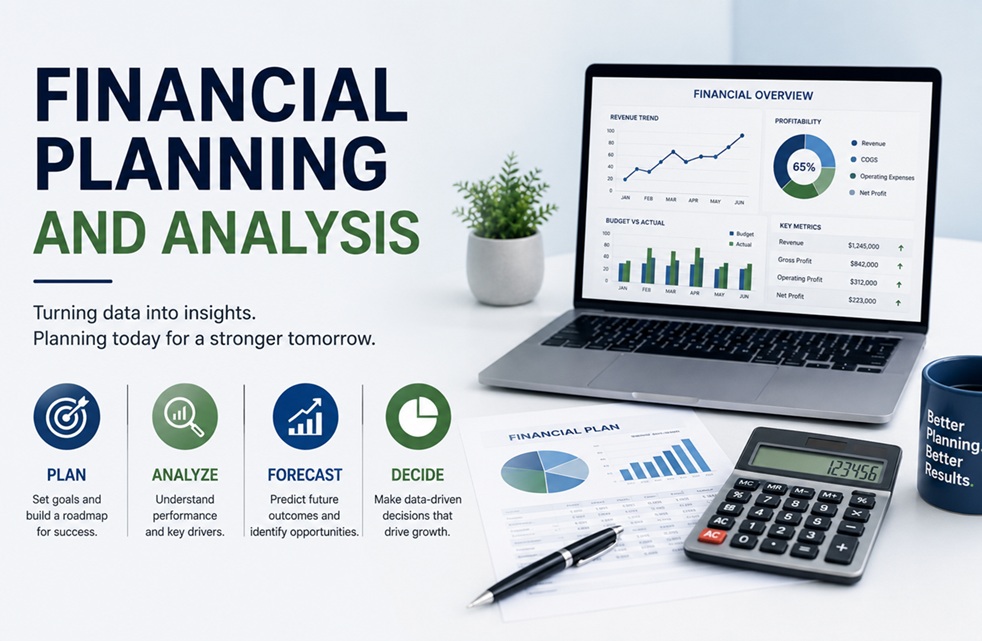
Financial Planning and Analysis (FP&A) is the corporate finance function responsible for budgeting, forecasting, variance analysis, and strategic decision support. While accounting reports what happened in the past and treasury manages today’s cash, FP&A looks forward — building the models and analysis that inform where the business goes next.
In practical terms, FP&A is the team a CFO leans on when leadership asks “should we hire 20 more salespeople?” or “what happens to margins if we raise prices 3%?” The function exists in companies of every size, though the title and structure vary — a startup might have one FP&A analyst, a Fortune 500 has hundreds spread across regions and business units.
The 4 Core FP&A Activities
| Activity | What It Produces | Who Uses It |
|---|---|---|
| Budgeting | Annual operating plan | All department heads |
| Forecasting | Updated outlook (monthly/quarterly) | CFO, board, investors |
| Variance analysis | Actual vs. plan explanations | Department heads, CFO |
| Strategic analysis | Business case models, scenarios | CEO, leadership team |
FP&A vs. Accounting vs. Treasury
People mix these three up routinely. The simplest framing:
- Accounting = past. Records what happened.
- Treasury = present. Manages cash, debt, banking.
- FP&A = future. Forecasts what’s coming and analyzes the options.
A good FP&A team works with both other functions — accounting feeds them historical data, treasury tells them about funding constraints.
A Typical FP&A Monthly Cycle
The rhythm in most companies looks something like this:
- Books close (days 1–5 of new month)
- Variance analysis on prior month (days 5–10)
- Forecast update for remainder of year (days 10–15)
- Leadership review meeting (days 15–20)
- Department check-ins for next-month planning (days 20–end)
Then it repeats. The faster the close, the more time FP&A actually has for analysis — which is one reason finance teams obsess over “days to close.”
Tools FP&A Teams Actually Use
| Category | Common Examples |
|---|---|
| Spreadsheets | Excel (still dominant), Google Sheets |
| Planning platforms | Anaplan, Workday Adaptive, Pigment |
| BI/visualization | Power BI, Tableau, Looker |
| ERP integration | NetSuite, Oracle, SAP |
Excel hasn’t gone away no matter how many vendors claim to replace it. Every dedicated planning tool still ends up exporting to Excel for ad-hoc work.
The Career Path
A common trajectory:
- Financial Analyst (0–3 years)
- Senior Financial Analyst (3–5 years)
- Manager, FP&A (5–8 years)
- Director, FP&A (8–12 years)
- VP of FP&A / CFO track (12+ years)
Salary ranges vary by industry and region, but FP&A roles consistently pay more than pure accounting at the same level, because of the strategic component.
What Makes Someone Good at FP&A
Modeling skills matter — but they’re table stakes. The analysts who get promoted tend to be the ones who can translate numbers into stories the business actually uses, ask better questions than they answer, know which assumptions matter and which don’t, and build models someone else can actually maintain.
The cliché “FP&A is a partner to the business” is overused, but it points at something real: the function only earns its seat at the table when it influences decisions, not just reports on them.
Bottom Line
FP&A is the analytical engine of corporate finance — forward-looking, decision-oriented, and increasingly important as companies face more volatile environments. If you’re considering it as a career, it offers a clear path toward CFO roles. If you’re a leader wondering what your FP&A team should be doing, the answer is simple: helping you make better decisions, not just reporting on the ones you already made.
