

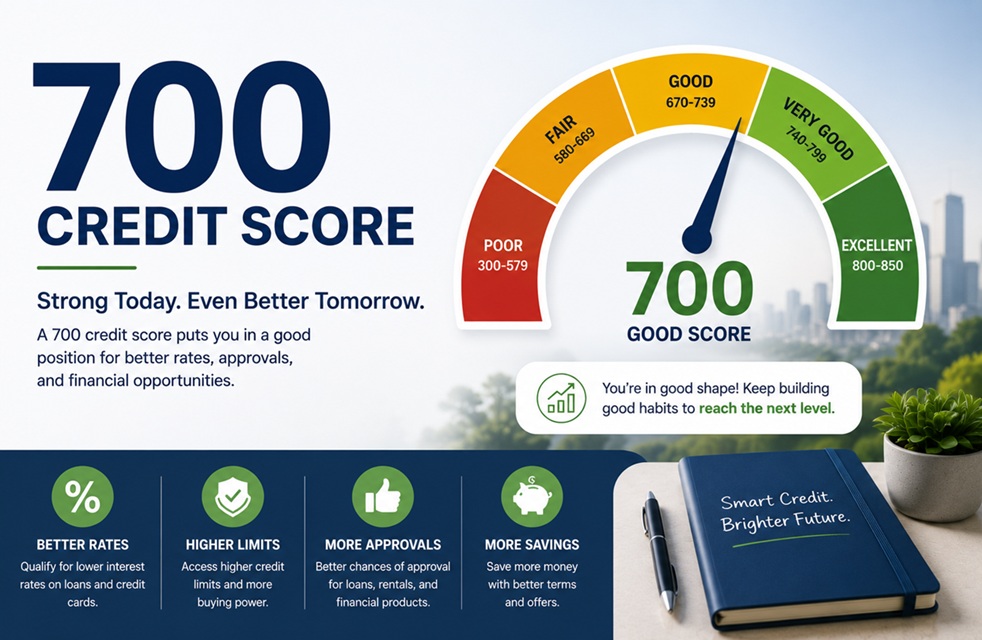
A 700 credit score sits in the lower end of FICO’s “Good” tier (670–739) and is essentially the gateway to mainstream credit. At 700, you qualify for most loans, credit cards, and rentals — but you’re not yet in the “Very Good” or “Exceptional” ranges where the best rates live. Roughly 21% of U.S. consumers have scores between 700 and 749.
The practical implication: at 700, you’ll get approved for most things you apply for, but you’ll typically pay 0.5%–1% more in interest on big loans than someone at 760+. On a 30-year mortgage of $300,000, that gap costs about $50,000 in interest over the life of the loan. Moving from 700 to 760 is one of the higher-ROI credit moves available.
Where 700 Lands
| Score | Tier | What Most Lenders Do |
|---|---|---|
| 670–699 | Good (lower) | Standard rates, almost all products |
| 700–739 | Good (upper) | Above-standard rates, full menu |
| 740–799 | Very Good | Top pricing tier |
| 800+ | Exceptional | Top pricing tier |
The next pricing-tier jump after 700 is at 740. That’s the target if you’re trying to improve.
What 700 Gets You Today
- Mortgages — approved at most lenders; rate roughly 0.5% above the best available
- Auto loans — competitive rates, but not manufacturer 0% APR offers (those typically need 720+)
- Credit cards — most rewards cards approve at 700; some premium cards target 740+
- Apartment rentals — usually approved without an additional deposit
- Personal loans — full menu of lenders available
How to Move 700 to 740+
Most 700 scorers have the foundations in place — on-time payments, established history. The leverage points are usually two specific things:
Credit utilization. If you have any cards running above 30% of their limit, paying them down to under 10% can move your score 30–50 points in 30–60 days. Score impact is fast on utilization changes.
Account age. Harder to game — it improves with time. But don’t close old cards (even if you don’t use them); keeping them open extends your average account age.
Beyond those two, the typical levers:
- Dispute any errors on your credit report
- Avoid opening new accounts in the 6 months before a major application
- Become an authorized user on a family member’s well-aged, well-paid card
- Don’t let any account go to a 30-day late, ever
What Hurts 700 Scores Fastest
A single 30-day late payment can drop a 700 score by 60–100 points. That’s the single biggest risk to stay aware of. The damage takes years to fully reverse.
Other things that drop scores:
- Running a credit card up to its limit (even if you pay it off later, the high utilization gets reported)
- Multiple hard inquiries in a short window
- Closing your oldest credit account
- Letting an account go to collections
The Rate Gap, in Real Numbers
Comparing 700 to 760 on a $300,000 30-year mortgage at roughly current rates:
| Score | Approximate Rate | Monthly Payment | Total Interest |
|---|---|---|---|
| 700 | ~7.5% | $2,098 | $455,000 |
| 740 | ~7.1% | $2,012 | $424,000 |
| 760 | ~7.0% | $1,996 | $418,000 |
That’s roughly $37,000 in lifetime savings just for moving from 700 to 760. The numbers shift with rate environments, but the relationship between score tiers and savings is consistent.
Common Misconceptions
“700 is a perfect score.” No — FICO maxes at 850, and the top pricing tier starts at 740–760 depending on the lender.
“My score is the same across all bureaus.” No — Equifax, Experian, and TransUnion can each report slightly different scores depending on which lenders report to which.
“Paying off a loan boosts my score.” Usually a small temporary drop. Mix of credit and average account age both ding slightly when an account closes. The score recovers in a few months.
Bottom Line
A 700 credit score is genuinely good — you can borrow on reasonable terms and aren’t paying junk-credit penalties. But you’re leaving money on the table on big loans. Spending 6–12 months focused on utilization and on-time payments to get to 740+ is one of the most profitable financial moves available. The work is mostly maintenance, not strategy.
