

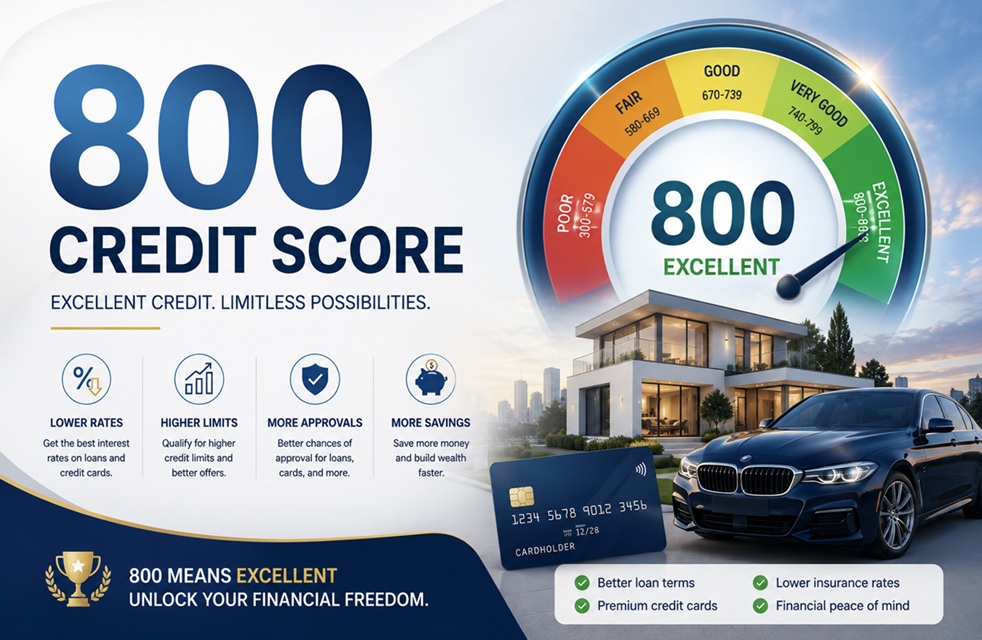
An 800 credit score lands in FICO’s “Exceptional” tier (800–850) — the top range, though not as rare as people assume. Roughly 23% of U.S. consumers have a FICO score of 800 or above, which means about one in four Americans qualify for the best rates lenders offer on mortgages, auto loans, credit cards, and most consumer credit products.
What an 800 doesn’t get you is anything meaningfully different from an 820 or 850. Once you cross 760–780, you’ve already hit the top pricing tier at most lenders. The score gains from there are real but don’t translate into materially better rates. The chase from 780 to 850 is mostly psychological — at 800, the work is done.
Where 800 Lands in the FICO Range
| Score Range | FICO Tier | What It Signals |
|---|---|---|
| 800–850 | Exceptional | Top pricing tier |
| 740–799 | Very Good | Top pricing tier (functionally the same as 800) |
| 670–739 | Good | Standard rates, most products available |
| 580–669 | Fair | Higher rates, some products restricted |
| Below 580 | Poor | Subprime market only |
The thing most articles get wrong: lenders price in tiers, not in single-point increments. The rate you get at 800 is the same rate you’d get at 780, in most cases.
What an 800 Actually Buys You
- Best mortgage rates — typically 0.5%–1% lower than someone with 680 credit
- Lowest auto loan rates — 4–6% lower than borrowers with sub-620 scores
- Premium credit card approvals — almost all rewards cards accessible
- Lower insurance premiums in most states (insurers use credit-based scores)
- Easier apartment and utility approvals — fewer deposits required
- Faster underwriting — fewer manual review hurdles
How People Actually Reach 800
The data is consistent across studies. People with 800+ scores share five habits:
- Long credit history — typically 15+ years of established accounts
- Low utilization — under 10% on revolving credit, often under 5%
- No late payments in the past 7 years — or only one isolated late, far in the past
- Healthy account mix — credit cards, auto loan, mortgage
- Few hard inquiries — usually 0–1 in the past 12 months
The fastest way to hurt an 800 is high utilization on a single billing cycle. The fastest way to maintain it is paying balances before the statement closes, even if you pay the full balance later.
What an 800 Doesn’t Do
- Doesn’t guarantee approval — lenders still look at income, DTI, employment
- Doesn’t dramatically beat a 760 — same pricing tier in most cases
- Doesn’t protect against fraud or identity theft
- Doesn’t transfer between scoring models — your FICO 8 might differ from your VantageScore 3.0
Common Misconceptions
“I need to use my credit cards a lot to keep my score high.” False. The opposite, actually — low utilization is one of the strongest predictors of high scores. Use cards lightly, pay them off.
“Closing old cards is fine if I’m not using them.” Risky. Closing old accounts shortens your average account age and reduces total available credit — both can drop your score.
“Checking my credit will hurt my score.” False. Pulling your own report (a soft inquiry) doesn’t affect your score at all. AnnualCreditReport.com is free.
How to Maintain an 800
- Pay every bill on time, every month
- Keep utilization under 10% (ideally under 5%)
- Don’t open new accounts unless you need them
- Don’t close your oldest cards
- Check your credit report once or twice a year for errors
Bottom Line
An 800 credit score is excellent — but it’s not a finish line, and pushing past it doesn’t unlock much. If you’re at 800, the right move is maintenance, not optimization. If you’re trying to get there from the 700s, the path is the same five behaviors that got you to the 700s — consistency over time. The score is a byproduct of habits, not a goal you chase with tactics.
