

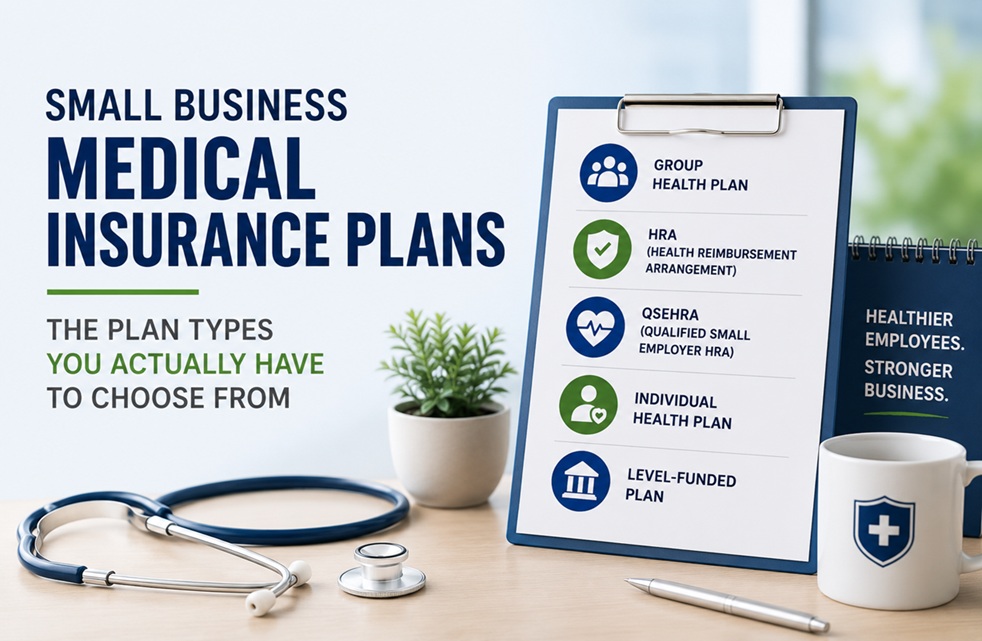
Small businesses have five distinct plan types to consider when offering medical coverage: traditional fully-insured group plans, SHOP Marketplace plans, level-funded group plans, ICHRA (Individual Coverage HRA) arrangements, and association health plans where available. Each has different cost structures, administrative requirements, employee experiences, and break-even points where it makes sense compared to alternatives.
The right choice usually depends on three factors: how many employees you have, how healthy the group is (since that affects fully-insured pricing), and how much administrative complexity you can manage. For most small businesses with 5–50 employees, the practical choices narrow to traditional group plans, level-funded plans, or ICHRA. The HealthCare.gov SHOP Marketplace publishes resources on the federal small business health insurance options, which is the starting point for understanding what’s available in your state.
The 5 Plan Types Compared
| Plan Type | Best For | Key Limitation |
|---|---|---|
| Fully-insured group plan | 5–500 employees, predictable health needs | Pricing tied to actuarial assumptions |
| SHOP Marketplace plan | 1–50 employees, simpler administration | Limited carrier choice in some states |
| Level-funded plan | 5–100 employees, healthier groups | Underwriting required; some risk shared |
| ICHRA | Any size; want flexibility | Administrative complexity; employee burden |
| Association health plan | Members of qualifying associations | Availability varies by state and industry |
Plan Type 1: Traditional Fully-Insured Group Plan
The classic small business health insurance arrangement. You contract with an insurance company that takes the full risk; you pay a monthly premium; the carrier handles claims and pays providers.
How it’s priced: Based on the demographic profile of your group (age, gender, location), expected claims, and the insurer’s loading factors.
Best for: Businesses that want predictable monthly costs and don’t want to manage risk.
Drawback: You pay the premium regardless of how healthy your group is. A healthy group subsidizes less-healthy groups in the insurer’s overall book.
Plan Type 2: SHOP Marketplace Plans
The Small Business Health Options Program (SHOP) is the federal small business marketplace, available to employers with up to 50 employees. Key features:
- Standardized plan comparisons
- Option to qualify for the Small Business Health Care Tax Credit (with 25 or fewer FTE and average wages below the threshold)
- Streamlined enrollment
- Pre-vetted carrier options
SHOP availability varies by state — some states use the federal SHOP, others run their own state marketplace.
Plan Type 3: Level-Funded Plans
Level-funded plans are a hybrid between fully-insured and self-funded. The employer pays a fixed monthly amount that covers expected claims, stop-loss insurance, and administrative fees. If actual claims come in below expectations, the employer often receives a refund or rate reduction.
Best for: Groups with healthy claims history; businesses willing to commit to underwriting.
Trade-off: Lower premiums than fully-insured if your group stays healthy; potentially higher costs if claims spike.
Many level-funded plans require medical underwriting at the group level — the carrier looks at the group’s overall health profile and adjusts pricing accordingly. Groups with serious chronic conditions may not qualify or may be priced uncompetitively.
Plan Type 4: ICHRA (Individual Coverage HRA)
An ICHRA is a newer arrangement (created in 2020) where the employer reimburses employees for individually purchased health insurance, pre-tax. Mechanics:
- Employer sets a monthly contribution amount
- Employees buy their own Marketplace plans
- Employer reimburses up to the contribution amount
Pros:
- Predictable employer costs
- Employees choose plans matched to their needs
- No employer-level group rating
- Can offer different contribution amounts to different employee classes
Cons:
- Administrative complexity
- Employees must navigate plan selection
- Newer arrangement; less broker familiarity
ICHRA has been growing significantly since 2020 because of the cost predictability and flexibility.
Plan Type 5: QSEHRA (Smaller Employer Variant)
QSEHRA (Qualified Small Employer HRA) is similar to ICHRA but only available to employers with fewer than 50 employees who don’t offer any group health plan. It allows tax-free reimbursement of employees’ individual health insurance and qualifying medical expenses up to annual maximums set by the IRS (typically a few thousand dollars per employee).
QSEHRA fits very small employers who want to help with healthcare costs but can’t or don’t want to sponsor a full group plan.
Plan Type 6: Association Health Plans
Some industry associations, chambers of commerce, and professional groups offer member access to group health coverage. Examples include the National Federation of Independent Business (NFIB) and various trade associations.
Availability varies by state and association. Worth checking if your industry has an association option, as group buying power can produce better rates.
How to Choose
A practical decision framework:
You have 1–5 employees: ICHRA, QSEHRA, or a SHOP plan. Group rates are often unfavorable at this size.
You have 5–25 employees: SHOP, traditional group, level-funded if your group is healthy, or ICHRA. Compare quotes from each.
You have 25–50 employees: All options worth considering. Level-funded becomes more compelling with size. The Small Business Health Care Tax Credit may still apply.
You have 50+ employees: You’re now an Applicable Large Employer (ALE) under the ACA. Traditional group plans, level-funded, or self-funded become primary options. ICHRA still works but administrative complexity grows.
What Drives Plan Costs
| Factor | Effect on Premiums |
|---|---|
| Employee demographics | Older groups cost more |
| Geography | Costs vary significantly by state and region |
| Plan design (deductible, copays) | Higher deductibles = lower premiums |
| Network | Narrow networks cost less than broad |
| Group health profile | Affects level-funded and self-funded |
| Carrier loading | Varies between insurers |
Common Mistakes
Choosing based on premium alone. A low-premium plan with a $7,000 deductible costs more out-of-pocket than a higher-premium plan with a $2,000 deductible if employees actually use healthcare.
Skipping the Small Business Tax Credit. Eligible employers often don’t claim it because they don’t realize they qualify.
Picking the cheapest network. Narrow networks save money but lead to surprise out-of-network bills if employees can’t find providers.
Not reviewing annually. Health insurance markets change; the right choice three years ago may not be the right choice today.
Bottom Line
Small business medical insurance plans aren’t a single category — they’re at least five different structures with different cost dynamics, administrative requirements, and employee experiences. The right choice depends on your size, your group’s health profile, your administrative capacity, and how much predictability matters versus how much upside you want from a healthy group. Get quotes for at least three plan types each year, and don’t assume last year’s choice still fits.
